
The transition from high school to college is often marketed as an exciting leap into personal independence and social discovery. While that narrative is undeniably true, it glosses over a harsher reality: it is also one of the most jarring, abrupt, and unforgiving academic shifts a student will ever experience.
In the American high school environment, your day is highly structured by default. You are confined to a physical classroom for roughly seven hours a day, teachers remind you constantly about upcoming homework, and academic success is frequently a byproduct of simply showing up, staying awake, and paying attention. The guardrails are everywhere, designed to keep you from falling off the track.
College flips this script entirely. When you enter the university system, you might find yourself with only two classes a day, leaving vast, unstructured stretches of “free time” that can easily deceive the untrained eye. No one checks if you did the reading before a seminar. Your parents aren’t there to monitor your wake-up times or lock down your digital distractions.
Worst of all, the assessment landscape changes drastically. In high school, your grade was cushioned by daily quizzes, participation marks, and extra credit. In higher education, your entire grade for a course might depend on just two high-stakes exams and a single term paper. Without a deliberate, systematic strategy, it is incredibly easy to fall behind before you even realize you are slipping.
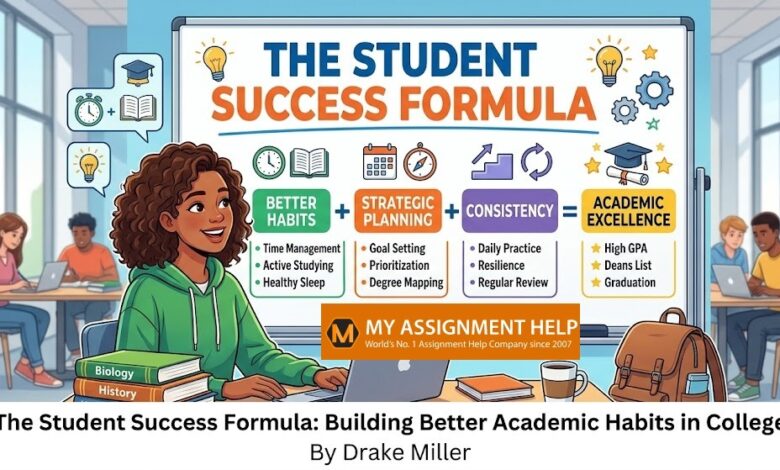
True academic excellence in higher education isn’t built on raw intelligence, nor is it sustained by pulling panic-induced, consecutive all-nighters. It is built entirely on sustainable systems. The “Student Success Formula” relies on foundational, daily habits that transform overwhelming workloads into manageable, bite-sized steps. This comprehensive guide outlines the essential habits and modern digital skills that high school seniors and college students must build to thrive academically in the United States university system.
1. How to Succeed in College by Reverse-Engineering Your Syllabus
In a university setting, the syllabus is not a mere welcome handout or a casual piece of paper to be thrown into the bottom of a backpack; it is a functional, legally binding contract between you and your professor. It outlines every expectation, reading assignment, grading rubric, policy, and deadline for the next fifteen weeks. The moment your courses open on your institutional Learning Management System (LMS)—whether your university utilizes Canvas, Blackboard, or Brightspace—your very first habit should be reverse-engineering your entire semester.
Instead of looking at your academic responsibilities through a narrow, week-by-week lens, high-achieving students utilize a systematic project-management strategy known as backward mapping. This technique involves looking at the ultimate destination—the final deadline—and working backward to establish micro-deadlines for yourself.
For example, if a heavy, 10-page research paper is due in Week 10, a strategic student does not wait until Week 9 to search for a quick fix or frantically think, “I need someone to do my homework for me ” Instead, they consciously reverse-engineer the project timeline across a multi-week sprint:
- Week 9: Devoted entirely to final editing, formatting, APA/MLA citation checks, line-by-line proofreading, and running peer reviews.
- Week 8: Executing the draft, writing the rough body paragraphs, and synthesizing transitions between major arguments.
- Week 6–7: Conducting deep literature reviews, building an annotated bibliography, and creating a highly detailed structural outline.
- Week 5: Finalizing the core thesis statement, gathering primary academic sources, and meeting with a research librarian to validate the scope.
By breaking massive, intimidating projects into these highly isolated micro-tasks, you eliminate the paralyzing anxiety that fuels chronic procrastination. You are no longer tasked with the monumental burden of trying to type my essay from scratch on a Tuesday night; you are simply “finding three academic articles” during a structured two-hour block.
Actionable Step: On the very first weekend of the semester, dedicate a two-hour block to aggregating every single deadline, exam, quiz, and project from all of your syllabi into a single digital calendar (such as Google Calendar or Apple Calendar). Color-code each calendar event by class. This visual mapping allows you to instantly spot upcoming “hell weeks”—those inevitable mid-semester periods where three exams and two major papers converge on the exact same two days. Spotting this weeks before it happens gives you ample time to prepare and distribute the workload early.
2. College Study Habits: Active Recall vs. Passive Review
Many well-intentioned students spend hours hunched over desks re-reading highlighted textbooks, rewriting beautiful, color-coded notes, and aimlessly scrolling through lecture slides. They finish a four-hour study session feeling exhausted and deeply satisfied, convinced they have mastered the material. Cognitive psychologists refer to this dangerous psychological phenomenon as the illusion of competence.
Because the information is sitting directly in front of your eyes as you re-read it, it looks deeply familiar. Your brain mistakes this superficial recognition for actual mastery. However, recognizing information when it is printed on a page is entirely different from retrieving that information from the blank recesses of your memory during a high-stakes, closed-book exam.
To truly encode information into your long-term memory, you must abandon passive review and embrace Active Recall. Active recall requires you to actively force your brain to retrieve information from scratch without looking at your notes or textbook, strengthening the neural pathways associated with that data.
The most effective, scientifically validated active recall strategies include:
The Feynman Technique
Named after the Nobel Prize-winning physicist Richard Feynman, this technique requires you to explain a complex academic concept in the simplest terms possible, as if you were teaching it to a middle school student or someone with zero background in the subject.
When you attempt to strip away academic jargon and explain a concept simply, you will inevitably hit a roadblock or find yourself struggling to articulate a specific point. The exact moment you stumble is the exact boundary of your knowledge. This technique instantly identifies the gaps in your understanding, allowing you to target your studying precisely where it is needed most rather than wasting time reviewing what you already know.
Flashcards with Spaced Repetition
Instead of reviewing a massive stack of physical flashcards in a linear, predictable fashion, utilize digital flashcard applications like Anki or Quizlet that run on spaced repetition algorithms.
Spaced repetition is designed to actively combat the human brain’s natural “forgetting curve.” The software tracks your performance: concepts that you find difficult are shown to you at frequent, tight intervals (e.g., every 10 minutes), while concepts you master are pushed further into the future (e.g., every 4 days). This optimizes your cognitive load and maximizes memory retention right before your brain would naturally discard the data as irrelevant.
Self-Testing Through Interrogation
Turn your lecture slide headers into direct questions. Instead of passively reviewing a slide titled “The Mechanisms of Cellular Respiration,” block out the bullet points entirely and demand that you answer a specific question aloud: “What are the three distinct steps of cellular respiration, and what are the exact inputs and outputs of each step?” If you cannot answer it accurately without looking, you do not know the material, regardless of how many times you highlighted it.
3. Implement the 2-Hour Rule for Time Management
The 2-hour rule dictates that college students should study for two hours outside of class for every one hour spent in a lecture.
In the American higher education system, this is the foundational benchmark for time management and workload expectations. If you are enrolled in a standard, full-time 15-credit load, you are spending roughly 15 hours per week sitting inside a physical or virtual classroom.
According to the 2-hour rule, you must layer an additional 30 to 45 hours of independent reading, research, problem-set practice, and assignment preparation on top of those contact hours. When you look at math, being a successful university student is quite literally a full-time job.
Managing this immense volume of work without experiencing severe burnout requires moving away from reactive, chaotic to-do lists and moving toward proactive scheduling systems.
The Pomodoro Technique
Human attention spans are a finite, highly exhaustible resource. To maintain high cognitive efficiency, work in highly focused bursts. Set a timer for 25 minutes of absolute focus—meaning your phone is completely turned off, social media tabs are closed, and your entire universe is narrowed down to your immediate coursework.
When the 25-minute timer rings, step away from your desk for a mandatory 5-minute break to stretch, hydrate, or rest your eyes. After completing four consecutive cycles, reward yourself with a longer 20 to 30-minute break. This rhythmic structure keeps your brain fresh, prevents cognitive fatigue, and stops the mental drift that leads to aimless internet browsing.
Time-Blocking and Strategic Outsourcing
Vague goals like “Study Chemistry this afternoon” are a recipe for failure because they fail to specify intention, leading to decision paralysis. Instead, block out your day in precise, realistic hourly chunks directly on your digital calendar. For example: 1:00 PM – 3:00 PM: Write Introductory Paragraph and Outline Section 1 for History Paper at the Library Main Floor.
However, even the most meticulous time-blocking can occasionally be disrupted by unexpected illness, incredibly dense reading assignments, or complex research parameters. When you struggle with intricate essay structures, advanced data analysis, or heavy research projects, remember that you don’t have to navigate it alone. Seeking expert guidance from dedicated expert academic support platforms can provide the structural assistance and clarity you need to master tough topics and keep your calendar on track.
Leveraging external expertise when appropriate is a smart project-management skill that ensures you never let one intensely difficult course completely derail your performance in your other subjects.
4. Optimize Your Physical and Digital Learning Environments
Where you study matters just as much as how long you study. Attempting to read a dense, peer-reviewed academic journal while lying horizontally in your bed, or sitting in the middle of a loud, chaotic campus student center, creates a massive wave of attention residue.
Every single time your eyes drift to a passing classmate, or your smartphone buzzes with a notification, your brain undergoes a rapid context switch. Studies show that it takes an average of 23 minutes for the human mind to regain deep, uninterrupted focus after a single, momentary distraction.
Optimizing your environment for deep work requires radical intentionality across two domains:
Physical Separation of Spaces
Never study, read, or write essays in your bed. Your brain is a highly responsive pattern-recognition machine that thrives on contextual cues. When you study in bed, you confuse your brain’s sleep signals. This leads to a double-edged sword of academic inefficiency: you will experience grogginess and low focus during your study sessions, followed by frustrating insomnia at night when your brain thinks the mattress is a place for intense intellectual labor. Keep your desk or your library space exclusively for work, and your bed strictly for rest.
Modern Digital Skills and Hygiene
In the modern educational landscape, your laptop is simultaneously your most powerful learning tool and your greatest distraction engine. Cultivating high-level digital skills means understanding how to ruthlessly manage your digital environment.
Do not rely on sheer willpower to resist the temptation of notifications. Proactively install advanced website and application blockers like Freedom or Cold Turkey to lock yourself out of social media, entertainment streaming services, and news sites during your dedicated time-blocks.
Furthermore, practice strict physical digital hygiene: place your smartphone on silent and slide it entirely out of sight inside your backpack or leave it in another room. If an electronic device isn’t actively serving your current learning objective, it is actively undermining it.
5. Build an Academic Support Network Early
One of the most damaging misconceptions that high school students carry with them into the university system is the belief that asking for help is an explicit sign of academic weakness or intellectual inadequacy.
In sharp contrast, utilizing institutional resources is the ultimate sign of academic maturity and strategic intelligence. The most successful college students are those who build a robust, comprehensive ecosystem of support long before they ever face an academic crisis or fail a midterm.
Maximizing Professor Office Hours
By university regulation, every professor is required to hold a set number of open office hours each week specifically dedicated to student inquiries. Tragically, these hours frequently go entirely unused, with professors sitting alone in empty offices.
Visiting your professor should not be viewed as a punitive measure or an emergency action reserved solely for when you are failing a course. Instead, use these hours early in the semester to gain deeper insights into complex readings, clarify the nuances of grading rubrics for upcoming essays, and discuss long-term career trajectories or research opportunities.
Building these genuine professional relationships early is critical; professors cannot write highly personalized, compelling letters of recommendation for your future graduate school applications or competitive internships if they only know you as a silent face in a 200-seat lecture hall.
Campus Writing Centers and Peer Tutoring
A massive portion of your tuition dollars goes directly toward funding campus academic resources, including writing clinics, mathematics centers, and peer-led tutoring networks. These services are entirely free to use.
Whether you need a trained peer tutor to walk you through a complex calculus theorem, or an extra set of professional eyes at the writing center to critique the structural flow of an argumentative essay, make it a recurring habit to visit these centers early in the writing or study process. Waiting until the night before a paper is due to seek help severely limits the utility of these collaborative spaces.
6. The Psychological Component: Mindset, Sleep, and Success
You cannot successfully build or sustain better academic habits if your physical and psychological foundations are fractured. Academic performance is not isolated from your biological health; it is inextricably linked to sleep hygiene and your underlying psychological mindset.
| Academic Pillar | Common Pitfall | Scientific Reality |
| Sleep Quality | Pulling all-nighters to cram before exams. | Deprives the prefrontal cortex; severely reduces memory recall and logical reasoning. |
| Mindset | Believing failure means you lack intelligence. | Viewing failure as actionable data to refine your study strategies. |
The Non-Negotiable Capital of Sleep
The concept of the “all-nighter” is heavily romanticized in contemporary college culture, viewed almost as a badge of honor or a right of passage. Scientifically, however, sleep deprivation is completely counterproductive to academic performance.
When you deprive your body of rest, you severely impair the functionality of the prefrontal cortex—the exact region of the brain responsible for logical reasoning, sustained concentration, processing speed, and working memory.
Pulling an all-nighter to cram for a morning test frequently results in a significantly lower score than if you had studied less but slept for a solid seven hours. This occurs because an exhausted brain simply cannot accurately recall the data you reviewed when you were sleep-deprived. Sleep is not a luxury; it is the exact biological mechanism where short-term memories are consolidated into long-term retention.
Cultivating an Adaptable Growth Mindset
At some point during your higher education journey, you will eventually encounter a course that challenges you profoundly. You may experience a moment where you fail a midterm exam for the very first time in your life. When this inevitable adversity strikes, students who possess a fixed mindset internalize the failure, believing they simply “aren’t smart enough” to handle the major or the subject matter, leading them to give up entirely.
In contrast, students who cultivate a growth mindset view a poor grade not as a permanent reflection of their identity, but as valuable, objective data. They look at the failed exam and ask analytical questions:
- What specific flaws existed in my preparation?
- Did I fall victim to passive review instead of active recall?
- Did I misinterpret the essay prompt, and did I visit office hours to clarify it?
- How can I adjust my daily habits to ensure a better outcome on the next assessment?
Resilience, adaptability, and the willingness to audit your own processes are the ultimate differentiators in higher education.
See also: Professional Internet System 602121861 for Businesses
Frequently Asked Questions
Q.1 What is the most effective study method for college students?
Scientifically, the combination of Active Recall (testing yourself without notes) and Spaced Repetition (reviewing information over expanding intervals) is the most effective study method. Unlike passive re-reading, these techniques force your brain to retrieve data, establishing stronger long-term neural paths.
Q.2 How do I handle a heavy college course load without burning out?
The best way to prevent burnout is through Time-Blocking and adherence to the 2-Hour Rule. Treat independent study periods like non-negotiable doctor appointments on your calendar, and use the Pomodoro Technique (25 minutes of focus, 5 minutes of rest) to maintain high mental stamina.
Q.3 What digital skills are essential for college success today?
Modern college success requires high-level digital organization and digital hygiene skills. This includes mastering cloud file systems, syncing institutional learning management platforms (Canvas/Blackboard) to your digital calendars, and using advanced application blockers to minimize mobile distractions during deep work.
Q.4 How often should a student visit their professor’s office hours?
You should aim to visit your professor’s office hours at least two to three times a semester per course. Go early to clarify complex syllabus guidelines or thesis concepts, rather than waiting until an academic emergency occurs right before final grading cycles.
Conclusion: Consistency Trumps Intensity
At its core, building better academic habits is not about executing a flawless, radical, and unsustainable overhaul of your entire life overnight. It is about the power of small, compounding daily actions.
Writing for just 30 focused minutes every single day is infinitely more effective than trying to write a 12-page research paper in a frantic, 12-hour blur of panic. Reviewing your lecture notes for a mere 15 minutes immediately following every class will save you from days of paralyzing panic during finals week.
As you transition into the university landscape and navigate the exciting world of higher education, always remember that the systems you put in place today dictate your successes tomorrow. Master your schedule through backward mapping, embrace the cognitive challenge of active learning, leverage your university’s physical and digital resources, and protect your physical well-being. By consistently applying this Student Success Formula, you will not only survive the academic rigors of college—you will truly conquer them.
About the Author – Drake Miller
I am a seasoned academic blogger at Myassignmenthelp.com, committed to producing insightful and student-focused content for learners at various educational stages. My work covers topics such as assignment help, academic organization, research methods, and effective learning strategies. Through practical insights and clear guidance, I aim to help students improve their academic outcomes, maintain motivation, and confidently overcome challenges throughout their educational journey.